Dawn Green – Writer

Weaving words worldwide


Leave a comment

Satisfy your wanderlust in Whistler

Image

Wander: the innate desire to travel or roam.

This word, combined with ‘lust’ to create Wanderlust, has transmuted into a muse for its founders, who tend to think of wandering in both an internal and external sense. “Obviously externally is going to new places, experiencing new cultures, taking in adventure and exploration and all that,” explains festival co-founder Sean Hoess, “but then internally with yoga and meditation it is bringing you into yourself, helping you find your centre and learn things about yourself spiritually and emotionally.”

This is the essence of Wanderlust, and for the second year running, over the span of four days this summer (Aug. 1 to 4), Whistler and Wanderlust will go hand in hand with creating a community around mindful living.

Quipped a “summer camp for adults” by Hoess, it’s truly a festival like no other. Its recipe for success is deceivingly simple – take a sprinkle of soul-soothing yoga, stir in rousing lectures alongside divine food and wine, and top it all off with euphoric dance sessions to the beats of leading musical acts and DJs.

And Whistler has emerged as a fabulous backdrop for the festival, remarks Hoess, his gauge for success stemming from a sense of instant acceptance and belonging.

“It’s an attitude – people seem to feel that yoga, outdoor activities and music all fit Whistler and we’re looking for places that think that way.”

Hoess divulges his top three choices for an unforgettable Wanderlust experience. Join a thousand people on yoga mats lining the Olympic Plaza for a part-yoga class, part-inspirational talk, part-dance party. It’s free and open to everybody; partake in a prana hike. The wildly popular meditation hikes entail trekking to a designated place deemed perfect for meditation, then being soothed by tranquil music, courtesy of a stand-up bass player; Farm to Table dinner – sit on top of Whistler Mountain at the Roundhouse Lodge and sample a feast of local foods and wines, a colourful collaboration by regional farmers and chefs.

Read the rest of the article, published in the Vancouver Sun and The Province on July 23, 2013.

http://www.theprovince.com/health/Satisfy+your+wanderlust+Whistler/8695275/story.html


3 Comments

Green initiatives in cities across the USA

The following is a guest post from freelance writer Cliff Barre, who, along with his wife Tiffany, travel the world as environmentally responsible tourists, documenting amazing green initiatives along the way.

Check out their blog Peace, Love & Travel with Cliff and Tiff: http://responsible-tourists.blogspot.com.au/

Green roof with solar panels on Gap corporate headquarters building

Green initiatives in cities across the USA

Those of us concerned with conservation and green initiatives often cringe when we see new developments springing up. In the past, new developments nearly always meant a glut of natural resources would be wasted to create some shopping mall, conference center or other amenity that may or may not be successful for more than a couple decades before crumbling into yet another monument to human excess and waste. Today, partially due to eco-friendly incentive programs available, many developers are beginning to make more eco-friendly choices when proposing and building new developments.

Take Chicago, for example. That’s a city gaining lots of green credibility, including some fine instances of creative reuse. The Museum of Science and Industry, the city’s main Veterans Affairs Medical Center and several other major buildings are using natural gas-based cogeneration plants. In such plants, the gas is burned for power as you might expect. You won’t find many exhaust vents for the byproduct steam though. It’s piped back through those buildings to heat their interiors instead. That’s no small thing during those Chi-town winters! If that doesn’t give you the warm feeling of sustainability done right, consider that each cogeneration plant is twice as efficient as conventional power generation systems.

Destiny USA, a large shopping mall in Syracuse, NY, has implemented a number of green initiatives. One of the most notable is the establishment of this development on a previously developed site. By reclaiming previously developed land, the developers of Destiny USA avoided encroaching on prime farmland, undeveloped natural habitats and other valuable natural resources. Additionally, the development of Destiny USA has, by careful attention to eco-friendly options, actually improved the quality of the land on which it is built. The most eco-friendly developments in our country incorporate plans for sustainability beyond initial development. Again, Destiny USA scores highly. Planners who chose the site location ensured that it would fall along regularly traveled public transportation routes. While most visitors can take public transportation to Destiny USA, who is LEED Gold Certified by the U.S. Green Building Council, those who choose other options are encouraged to find eco-friendly transportation. The location boasts 200 convenient bike racks as well as showers and changing rooms for employees who choose to bike to work. Those with electric cars can take advantage of prime parking equipped with charging stations.

When a plan for using empty roof space in San Francisco to generate power for the city was first proposed, critics scoffed that Fog City would never get enough sunlight to make the green initiative a success. However, photovoltaic cells that produce electricity don’t need full, direct sunlight. In 2004, 60,000 square feet of photovoltaic cells were installed atop San Francisco’s Moscone Convention Center. The success of this project has led to installations on a number of other buildings including libraries and municipal buildings.  Like Destiny USA, the Moscone Convention Center has become LEED Gold Certified.  For San Francisco, going green has become a mere matter of letting the sun continue to shine.

As noted earlier, these are only a few of the many green initiatives being incorporated nationwide. While no single initiative is enough to reverse the ongoing concerns of global warming and carbon emissions, each initiative gets us as a human race closer to the ultimate goal of true sustainability for life on this planet.

images


Leave a comment

There’s no such thing as a perfect pollinator garden

pollinator3

They are the unsung heroes of our world, quietly going about their business of pollinating plants, barely noticed by many, yet at the same time critical to our planet’s survival. We call them the pollinators – the bees, beetles, butterflies, wasps, moths, bats and hummingbirds – organisms that carry a plant’s pollen grains from one part of the plant (the anther) to another (the pistil) to assist in its reproduction process. Yet despite their significant role in agriculture and nature, worldwide evidence show pollinator numbers are plunging.

This is all the more reason to take on board the project to create your very own backyard pollinator garden – one that will provide essential habitat for these indispensable insects and birds. And fortunately for those of us who may not be as green-thumbed as others, this is a fairly simple task which can be done in any backyard, regardless of size.

To start off, consider designing a garden which phases through a continuing cycle of blooming plants from spring to autumn. This will ensure that the garden can supply nectar and pollen for a variety of pollinators with a variety of foraging habits and flower preferences.

When it’s time to decide on which flowers to grow, choose native plants which are better adapted to their region and better able to provide for pollinator’s needs than non-native plants. And remember that flowers sporting bright colours, especially yellow, blue, red, and violet are especially alluring to pollinators.

There are other vital aspects to a pollinator garden besides the flowers. Some pollinating insects like to nest in the ground so it is a good idea to preserve open patches of undisturbed ground for these critters. Dead wood is often home for wasps, bees, ants and beetles, so another way to encourage the nesting of pollinators is to retain dead tree branches and logs.

Water is essential to all life, so add water to the mix by hanging a small container of water out in the open or keep a bird bath nearby and you might be surprised to see butterflies gathering and sipping the fluid.

Your garden should aim to be pesticide-free – pesticides can be deadly to pollinators, who alight on the sprayed plants and ingest tainted nectar or pollen.

The key element to pollinating success is adjusting our society’s insatiable need for perfectly manicured yards, sums up Squamish resident Meg Fellowes.

“We need to re-examine what we find aesthetically pleasing – meadows are alive with butterflies and bees, lawns are sterile wastelands.” 

~ An excerpt from my article written for the Whistler Question, April 2013


1 Comment

Ecotherapy – healing through the embrace of nature

Image

We can all attest to feeling it on some level – that moment when we leave our personal problems behind as we step into the warm embrace of nature, whether it be a green, mossy grove or a rocky mountain peak. And now there’s an emerging science devoted to promoting healing ourselves through nature.

According to American pastoral counselor Howard Clinebell – a pioneer of the ecotherapy movement – this therapy, in a nutshell, refers to a diversity of nature-based methods of healing.

Ecotherapy takes into account the latest scientific understandings of the world and the deepest indigenous wisdom.

“This perspective reveals the critical fact that people are intimately connected with, embedded in, and inseparable from the rest of nature. Grasping this fact deeply shifts our understanding of how to heal the human psyche and the currently dysfunctional and even lethal human-nature relationship. It becomes clear that what happens to nature for good or ill impacts people and vice versa, leading to the development of new methods of individual and community psychotherapeutic diagnosis and treatment.”

Dr. Michael Cohen is another such pioneer. A distinguished eco-psychologist and environmental scientist residing in Washington State, he has dedicated his sixty-year career to researching and teaching natural attraction ecology.

The Webstring natural attraction model he has developed recognizes humans as being part of the eons-old dance of the web of life – each member of the web, whether it be a bacteria or a human, has its own unique relationship to the whole.

“Industrialized society socializes us from childhood into a nature-disconnected story that excessively exploits nature’s balanced essence, even as that ancient energy dances in, through and around us,” Dr. Cohen explains. “The root of the problem is that we deny we have been indoctrinated into this story – this keeps us tied to exploitative patterns of thought and behaviour that perpetuates the industrial myth.”

The end result of living the industrial myth is obvious – we are out of touch with our natural way of knowing and with our inherent sensitivity to the natural world. And it’s not just the environment that is deteriorating; our personal and social well-being degrades alongside it.

John Scull knows the answer to why ecotherapy works. After all, he worked as a registered psychologist for 35 years, and practiced ecotherapy for the last four years of his career, he tells me during a phone interview from his home in Duncan on Vancouver Island.

Scull studied under Dr. Cohen, who spoke about the powerful sensory and nature reconnecting processes that enables us to restore wellness to our nature-disconnected psyches.

“It’s more than just walking in nature,” Scull said. “Anybody can go outdoors, but that’s not therapy. You’ve got to be outdoors and mindful of your connection to nature and that’s what ecotherapy is all about. Going out and really processing the lessons that nature has to teach us about how to live our lives and how to be in the world.”

This is a three stage process, he explained.

Part one is to give yourself an intention before you go out in nature, part two is to be quiet when you’re there, and part three is to process the experience and bring it back into your life, done with a therapist and also with journalling.

eco therapy

One of the exercises, out of the hundreds used, involves going out and breathing in a plant. Yes, it sounds odd, he says, but what it means is to go out and find a plant, and hold the image in your mind of how the plant is producing oxygen and how you’re producing carbon dioxide and meditate on that connection while you’re breathing and then hold your breath too.

“It’s a really good way to get people into the notion of inter-connectedness,” he said, “that they’re not alone, that they have a reciprocal, interactive relationship with the natural world, that without plants we wouldn’t be able to breathe and without carbon dioxide, plants wouldn’t be able to breathe.

“There’s a lot we learn from interacting with the natural world. We learn about things that are permanent, we learn about things that are interconnected – the idea is to learn to live our life in more harmony with the way nature works. The only way you get that is by experiencing it mindfully.”

He points to a growing body of scientific literature about the positive effects of ecotherapy and concedes that ecotherapy is part of a larger movement which is marching forward.

It could be the crystal ball into the future

Seeing as we evidently survived the end of the world predicted by the Mayans on December 21, what lies ahead for our society of self-created eco-zombies?

American author and journalist Richard Louv makes a convincing case that through a nature-balanced existence – driven by sound economic, social, and environmental solutions – the human race can and will thrive.

“The future will belong to the nature-smart – those individuals, families, businesses and political leaders who develop a deeper understanding of the transformative power of the natural world and who balance the virtual with the real. The more high-tech we become, the more nature we need,” he says.

Our society, Louv states, has developed such an over-sized faith in technology that we have yet to fully realize how human capacities are enhanced through the power of nature. Tapping into the restorative powers of the natural world can boost mental acuity and creativity; promote health; build smarter and more sustainable communities, and economies; and ultimately strengthen human bonds. As he describes in his book, The Nature Principle,we are entering the most creative period in history. The twenty-first century will be the century of human restoration in the natural world.

(Published January 18, 2013 in Greenster, environmental online magazine)

http://www.greenster.com/magazine/ecotherapy/


Leave a comment

Embracing winter snow sports

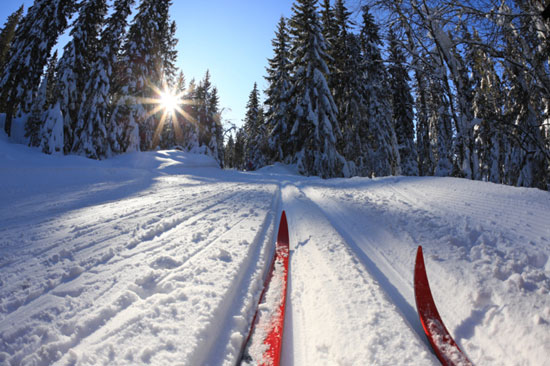
nordic-skiing

When winter blankets North America in her white, wispy shawl of snow, many of us turn instinctively to hibernation-like habits to survive. But, as it turns out, we were meant to get out there and move. Just look at our ancient ancestors – enduring the howling winds and waist-deep snow of winter, thousands of years ago they turned to nature for inspiration and survival tactics. Observing the snowshoe hare with its over-sized feet, bounding effortlessly on top of the snow, the idea for a shoe specifically designed for snow travel was born. Made of white birch or ash wood and weaved with the hides of deer, the invention of the snowshoe dramatically altered the lives of these people forever.

During the course of centuries, the snowshoe was strictly necessary for all peoples confronting deep snows in winter, to enable them to hunt, trap and travel long distances. When French fur traders settled in what is now Quebec in the early 1600s, they were introduced to snowshoeing by the First Nations people. This allowed them to carry on with their trading throughout the long winter months, and from there the concept of snowshoeing spread out over the Northern Hemisphere.

Today snowshoeing is generally viewed as a winter recreational activity and a way to get back to nature, with the resurgence in its popularity acknowledged as a nod to the past. So strap on your snowshoes and explore the snowy terrain, where the only thing stopping you is your growing appetite after a good work-out in the snow.

And if travelling by ski is more your style, take on the thrills and spills, Nordic-style.

As for me, I would never consider myself a fearless Nordic skier, but I was feeling rather self-assured on this particular day in Callaghan Valley, B.C. Having glided my skate skis across virgin tracks, past snow-laden trees under dreamy blue skies, one measly slope stood between me and a steaming thermos of tea. I hesitated as two ski patrollers on their ski-doo waved for me to come down, but then brazenly pushed off. I nearly made it … then my left ski stopped co-operating and my previously graceful movements descended into an awkward struggle for balance. Sure enough, gravity won out and I face planted in front of my audience. I’ll give them points for not laughing, but I know underneath their scarves they were grinning. And I was too.

Blissful Nordic skiing and seriously exceptional snowshoeing take the cake in terms of the ultimate way to experience winter head-on. So the next time you peer out the window to the doom and gloom of winter, resist the urge to jump back in bed and pull the covers over your head and instead embark on a Nordic skiing or snowshoeing adventure. Guaranteed it’s a better way to get through winter, with the perk of staying fit too.

(Published December 19, 2012 in Greenster, environmental online magazine. http://www.greenster.com/magazine/snowshoe-skiing/)


Leave a comment

Searching for solace on the summit


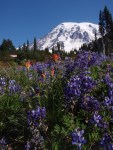
Mount Rainier

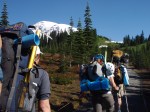
We were each here for our own reasons – for my husband it was his first-ever high altitude mountaineering trip, for Helen it was all about conquering a defeat (her past attempt in 2009 resulted in being turned away a mere 305 metres from the summit due to tremendous winds), for Paul it was his sixth time on a mountain he loved, yet never underestimating its immense power. For Dane, I am not certain, as he said little, but he had his reasons, one of which was an incredible passion for climbing mountains and embracing life.

As for me, I was here to document the voyage and would travel up as far as Camp Muir, the base camp from which the team would leave for their summit push.

It was a clear July morning when we all bundled into Paul’s station wagon and headed down the I-5 south from Seattle towards the mountain. Like a magnet, my eyes were drawn to it – the only mountain on the horizon, it sat there, watching and waiting.

A few hours later, we found ourselves in paradise, literally.

Paradise ranger station sits at the end of the road in the national park – the rest of the way up was by foot.

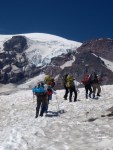
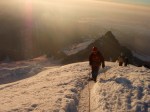
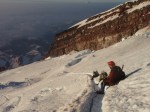
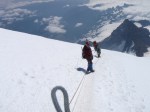
Alpine wildflowers greet us in a swirl of colour as we climb, giving way to rock and then ice fields higher up. Following in the footsteps other climbers had kicked in the snow, we trudged upwards, reaching our destination six and a half hours later.

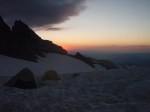
Camp Muir, 3,048 m, hosts a ranger station, solar toilets, a public shelter and a multitude of brightly coloured tents dotting the glacier. From here the team headed out in the dark in their summit attempt the following evening, while I stood shivering in the cold and watched their bobbing lights.

After an agonizingly long wait, including a false alarm when I saw a group descending and rushed out to greet them only to be peering into stranger’s curious eyes under all their gear, the team trooped down towards camp, elated but knackered.

Each one of them was moved by the experience of standing on the summit of Mount Rainier.

To read about their profound revelations, click to the full article here:

Pique – Nov. 12


Leave a comment

Take to the trees – Take Me Outside Day – Oct. 25

It’s true… kids these days can spend up to 8 hours a day sitting in front of a computer screen.
Yikes… that’s a hard pill to swallow.
But luckily there is relief in sight – today is Take me Outside Day – a fabulous initiative to change that trend.
Last year, Colin Harris, founder and executive director of Take Me Outside ran more than 7,600 kilometres, the equivalent of 181 marathons from St. John’s, N.L. to Victoria, B.C.  Along the way, he went into 80 schools and chatted with almost 20,000 students about the importance of finding better balance with the amount of time they spend outside compared to the time they are spending in front of screens.
Today more than 15,000 students across the country have committed to spending 30 minutes or more outside, to raise awareness about the importance of unplugging and spending time outside.
Because nothing beats being active and connecting with nature.
It’s good for the body and for the soul, and is as effective for kids as well as adults.
I know I am happy to commit to spending more time outside today – speaking of which, it’s time to head out the door to go walk amongst the big cedar trees while the autumn sun glimmers through the trees and sparkles on the water top.
~Dawn
For more info on the organization, check out: http://takemeoutside.ca


Leave a comment

Curtain closing on summer

When the first twinge of crispness can be felt in the air, alongside the ever-shorter days and the odd leaf swirling down to the ground, one knows summer is slowly leaving the stage, to soon be replaced by the colourful transformation of autumn. Another indication of autumn is, of course, the harvest when farmers are finally able to reap the benefits of their hard, earnest work at tending their crops. It’s a time of celebration and festivity as we feel gratitude to the bounty of the land.

This bounty can be experienced for non-farmers via a new popular trend – the emergence of local farmers’ markets, which now swell with people on weekends who are eager to source fresh food, to eat locally and support their farmers.

Here in Squamish over the past five years, we’ve witnessed this exponential growth and each Saturday throughout the summer and fall, a car park area in the downtown booms to life with adults, kids, dogs, musicians, artisans and farmers. It’s a truly happy place to go to mingle, eat, listen to music and feel that sense of connectedness within a community.

So savour the last days of summer, nibble on homemade goodies, catch up with that friend or neighbour you’ve been meaning to see and feel the life of the people around you… before the rains return and we dash around town under umbrellas, with summer a distant memory we clench onto in order to help us carry us through.

~Dawn


Leave a comment

Building a wetland 101

This slideshow requires JavaScript.

Sea-to-Sky Wetlands Institute – July 2012

A few weeks ago I had the immense privilege to witness an incredible sight… the building of a wetland. As you can imagine, this was no easy feat, but not even the heat nor the incessant mozzies (mosquitoes for North Americans) could put a damper on the enthusiasm. Here we had a diverse group of 30 people from all over B.C. convening in the Sea to Sky Corridor to participate in the BC Wildlife Federation’s (BCWF) week-long Wetlands Institute. It is a crash course designed to help educate citizens on how to successfully tackle restoration/conservation projects in their own communities.

On July 14, I joined the lively crew as they worked with Edith Tobe, executive director of the Squamish River Watershed Society to create small wetlands near West Brohm Creek, just outside Squamish.

The society has already created a successful wetland habitat in that area, which is attracting red-legged frogs and bass, said Neil Fletcher, BCWF wetlands education coordinator.

“For their size they have disproportionately more species using them than any other ecosystem,” Fletcher said of wetlands.

In B.C., 144 bird species rely on wetlands and 44 different mammals – a lot of which are either on the blue or red list of animals at risk. Fifty to 85 per cent of wetlands have been developed throughout the province, Fletcher said.

“We are just part of a movement trying to reverse that trend.”

So, how do you go about making a wetlands?

Step 1:

Roll out the enormous sheet of liner, measure the dimensions and cut… sorry, I didn’t record the actual measurements, I was too memorized by the flurry of activity to make that all happen!

Step 2:

As a team, roll up the liner and then carry it to the designated wetland location, which had already been dug up, thanks to the excavator.

Step 3:

Remove oversize rocks, roll out the liner, walk as a group in a circle to pat it down. Then add water and voila!

Hmmm…. hey kids, just a heads up – don’t try this at home without first checking out and taking part in the Wetlands Institute.

To find out more, click to www.bcwf.net and the amazing and informative Bog Blog www.bcwfbogblog.com.